
Lenoir Court Records Access Routes
Every Lenoir County court file starts with a paper trail. The Clerk of Superior Court keeps it. That office holds Superior Court and District Court records: criminal, civil, special proceedings, estates, and matters tied to the magistrate. But you can look first from home. The North Carolina eCourts Portal lets you search a public case, open a Register of Actions, and view any public document posted there. Treat the Portal as a reference route, though. When you need the official Lenoir file, a plain copy, a certified copy, older paper material, or help reading a result, the clerk's office is the place to go.
Before you call or drive over, it helps to see how record requests work statewide. The Judicial Branch's obtaining court records information walks through public terminals, clerk files, and how paper-file inspection works, so you know what to ask for at the counter.
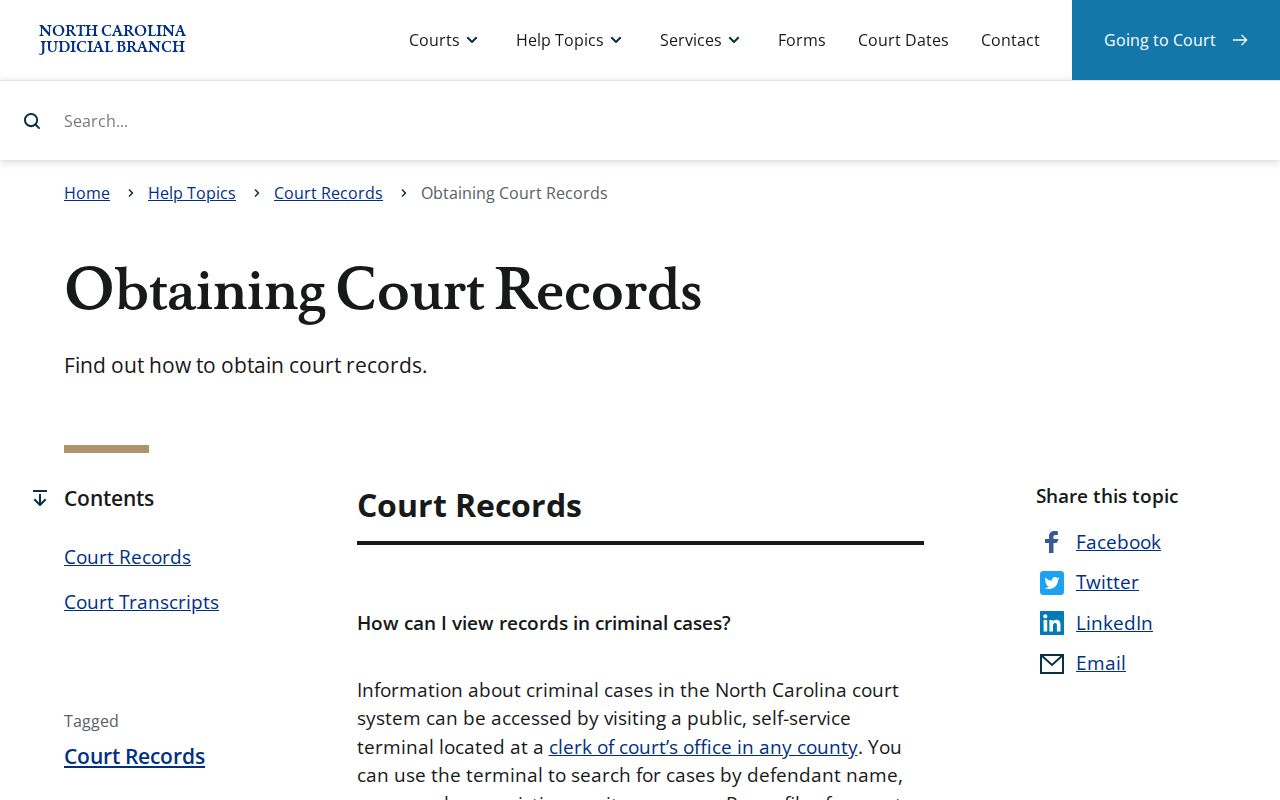
State guidance points to a Lenoir approach that pairs the Portal with the local clerk. An online display never shows every record that exists. At the courthouse, public self-service terminals serve as an official fallback. Criminal searches can run by name, case number, victim, or witness. Civil, special-proceeding, and estate matters each have their own court-system routes. In person, ask to inspect a file. You can also request a specific copy. By phone, the Lenoir clerk's documented number is (252) 520-5300. The state's public-record request process covers Judicial Branch administrative records only. It does not replace a county case-file request.
How to Get Court Records
A Lenoir request goes smoothly when it names the case number, court division, document title or event date, and whether the copy should be plain or certified. The Portal can show public information and documents. A missing document does not prove it never existed. Older paper files and restricted material need clerk handling. Lenoir offers no universal web form covering every document type, no documented email or fax document-order route, and no published turnaround.
- Use the eCourts Portal to find the Lenoir case number, court division, and exact document or Register entry sought.
- Open any public document the Lenoir case view makes available, while recognizing that confidential, sealed, sensitive, and older material can be unavailable online.
- Visit the clerk counter or public terminal to inspect a Lenoir file or request a plain or certified copy; call (252) 520-5300 for local routing first.
- State the document and copy type, then ask the Lenoir clerk for the current total and payment method before ordering.
- Use the separate NCAOC administrative public-record route only for administrative records, not to bypass a Lenoir court-file request.
Mail is documented locally for payments, not as a blanket mail-order method for court documents. The Lenoir payment instructions direct mail payments to the Clerk of Superior Court, PO Box 68, Kinston, NC 28501, by money order or certified check rather than cash or a personal check. Confirm with the clerk before assuming that instruction covers a copy request.
Lenoir Register Is Not Official Record
Three Lenoir items look alike but do different jobs. The Register of Actions is the Portal's public chronological summary of a case. A filed document is the pleading, order, judgment, notice, affidavit, or attachment. It sits behind a docket event. A certified copy is official, supplied and authenticated by the Clerk of Superior Court. The Portal guide says it plainly: the Register is not the official court record.
| Lenoir record layer | What it provides | Proper source |
|---|---|---|
| Register of Actions / Case Summary | Public event history and case context. | eCourts Portal or clerk terminal. |
| Filed court document | A public pleading, notice, order, judgment, or other case item when available. | Portal if visible; otherwise the Lenoir clerk file. |
| Certified copy | Clerk-supplied official court document or certified record. | Lenoir Clerk of Superior Court. |
A Lenoir judgment amount shows why this matters. A Portal index may give status context. The official guide points users to Smart Search and the Register's Dispositions area for detail, and to the county clerk for a current official amount.
Types of Court Records
Lenoir court records sit inside North Carolina's unified General Court of Justice system. There are no separate county and district clerks. Superior Court handles felonies and major civil paths. District Court handles lower-level criminal matters, traffic and infractions. Civil matters within its jurisdiction, domestic matters, juvenile matters, and many magistrate-connected actions also land there. Across all of those court-file categories, the Clerk of Superior Court is the practical Lenoir gateway.
- Public case chronologies or Registers of Actions for visible case types.
- Filed pleadings, notices, orders, judgments, and related public documents.
- Criminal and infraction record-search material within the clerk's documented process.
- Civil, estate, special-proceeding, and magistrate-connected Lenoir files.
- Transcript or recording requests routed through the applicable court-reporter or digital-recording process.
Land and vital records belong to the Register of Deeds instead. So name the court case or document when you request it. That keeps the request with the correct Lenoir office.
Lenoir AOC-CR-314 Record Search
Need a certified criminal-record search for Lenoir County alone? The statewide AOC-CR-314 form does exactly that and nothing more. It is not a catch-all request for judgments, civil filings, or docket sheets. The form asks for every name a person may go by, lets you flag criminal and infraction records, and leaves the certification fields for the clerk to complete.
One caution before you rely on the result. The clerk's indexes run on names. A no-result reply does not rule out a record under a different name or one that cannot be disclosed. Juvenile records will not show up through this search either. For the fee and the fine print, the Judicial Branch's official criminal-record-search information lists the certified single-county search fee at $25 and explains what the search covers.
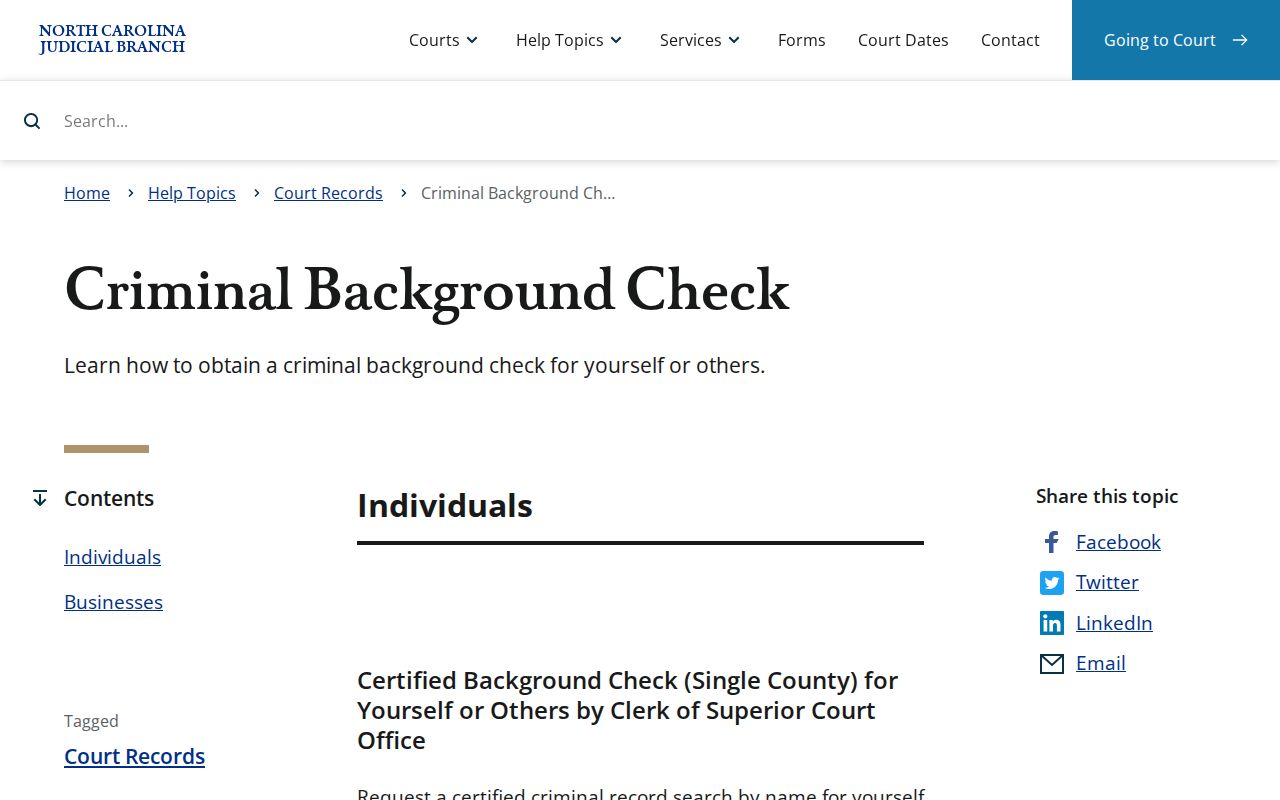
The Lenoir version stays county-specific. The clerk's certification and raised seal set it apart from any public online case summary.
What a Court Record Contains
A public Lenoir court record usually holds more than a case title in a search result. The file and Register can show identifiers and case classification. They also cover parties, dated activity, court events, dispositions, and public financial or document information. Contents differ case by case. Public-access restrictions limit what appears. The table describes the documented record layers. It does not treat every item as available in every Lenoir file.
| Case number | The court-assigned identifier used to locate the Lenoir case and its Register. |
|---|---|
| Parties and case type | Public caption and classification data, subject to redaction and access rules. |
| Register of Actions | Dated public events based on the clerk's official record; it is not itself the official record. |
| Pleadings and notices | Filed case documents when public and available through Portal or clerk file. |
| Orders and judgments | Rulings and judgment documents that may need a clerk copy or certification. |
| Hearings and dispositions | Public setting and outcome information, which should be read with current calendar or clerk context. |
| Financial information | Public payment or judgment context, with current official amounts confirmed by the Lenoir clerk. |
Want a hearing transcript? Ask the Lenoir clerk or the court-reporting channel. Ask what record exists for your proceeding. Statewide records guidance sorts court reporters, digital recording technicians, and transcriptionists into separate roles. So a docket request can never force the clerk to produce a transcript.
Lenoir Clerk Copy Fee Details
Copy fees in Lenoir County come straight from the statewide statutory schedule, G.S. 7A-308. The clerk charges by the page. A plain court document runs $2 for the first page. Then it costs $0.25 for each additional page or fraction of a page. Want it certified? A certified judgment, order, docket, or Register copy adds the copy charge. It also adds any certificate under seal. The clerk of court posts no single price list or turnaround covering every certified document. So ask for a Lenoir total before you order.
| Document or service | Documented amount |
|---|---|
| Plain individual court document, first page | $2 |
| Each additional page or fraction | $0.25 |
| Certificate under seal | $3, in addition to applicable copy charges |
| Exemplification | $10 |
| Certified single-county criminal-record search, AOC-CR-314 | $25 |
These amounts cover two different things. One price is for document copies; the other is for certified name-search service. Neither is a locally published fee schedule, so a transcript, archive pull, or special request may cost something else.
Certified Copies and Fees
A plain Lenoir copy is fine for reading. A certified copy is different. The clerk issues it as an official court document, and the AOC-CR-314 shows why: every certified page bears the clerk's raised seal. An exemplification is its own statutory service on top of that. So do not treat a Portal Register printout, a judgment result, or any public document printout as equal to a clerk-certified copy. It is not.
Be specific with the Lenoir clerk. Name the document, the case, and the certificate type you need. The clerk can quote the total and tell you whether the item is public, available at the counter, or requires another authorized process.
Lenoir Paper Files After eCourts
Lenoir joined eCourts in April 2025. Current case access now runs through Enterprise Justice/Odyssey, the Portal, and File & Serve. The switch did not put every Lenoir historical file online for anonymous download. Older or pre-go-live paper files may still need inspection or retrieval. That happens through the Clerk of Superior Court. It keeps the public terminal and clerk counter important next to the Lenoir Portal.
The Lenoir eCourts go-live release spells out the roles of the Portal, File & Serve, and Odyssey. File & Serve handles electronic filing for registered filers. It is not a public record-search substitute. A filed copy delivered through it also differs from a general public Portal result.
Lenoir Court Record Transcript Routes
A Lenoir Register of Actions is not a hearing transcript. For the spoken record, ask the clerk or the applicable court-reporting channel. Ask what exists and how to request it. State guidance splits the field into court reporters, digital recording technicians, and transcriptionists. So the custodian, and even the fee, can turn on how the proceeding was recorded.
When you ask, bring the details that make routing possible. These include the Lenoir case number, the date, the court division, and the specific proceeding. There is no universal transcript charge or processing timetable for Lenoir County. A clerk or court-reporting inquiry will always beat guessing that the ordinary copy schedule applies.
Public Access and Sealed Records
Lenoir public access starts with the clerk-held court file and the public Portal view. Both have limits. Sealed court records, confidential records, sensitive-content documents, juvenile material, unreturned warrants, and restricted proceedings stay off the ordinary public Portal. None of that appears there. A visible case index does not mean every filing inside is public. And a no-result search does not prove a confidential case is absent.
G.S. 7A-109 is the core authority for clerk-maintained court records and indexes. G.S. 7A-308 provides clerk-fee authority. G.S. 15A-151 protects covered expunged records, and G.S. 7B-3000 addresses juvenile-record confidentiality.
The clerk and the court process control authorized access. No standard Portal search or general copy request overrides an order or statute restricting a Lenoir file.
Lenoir Clerk Versus Public Records
Chapter 132 is North Carolina's general public-records framework. It sets the backdrop for access, but court files answer to more specific rules. Judicial statutes, confidentiality provisions, and the clerk's custody of the case record govern them. A Lenoir case-document request starts with the Clerk of Superior Court. Skip the generic county-agency records route.
The Judicial Branch's administrative public-record route still matters for material held by NCAOC. It cannot replace a Lenoir clerk request. That covers a judgment, a court-file document, Register certification, a transcript route, or a historical case file. Each office keeps what it maintains. That division keeps your request where the record actually lives.
No source publishes one universal deadline for every Lenoir court-record request. Confirm timing with the clerk. The statute page linked above covers the general framework. Use it as a solid Lenoir access reference.
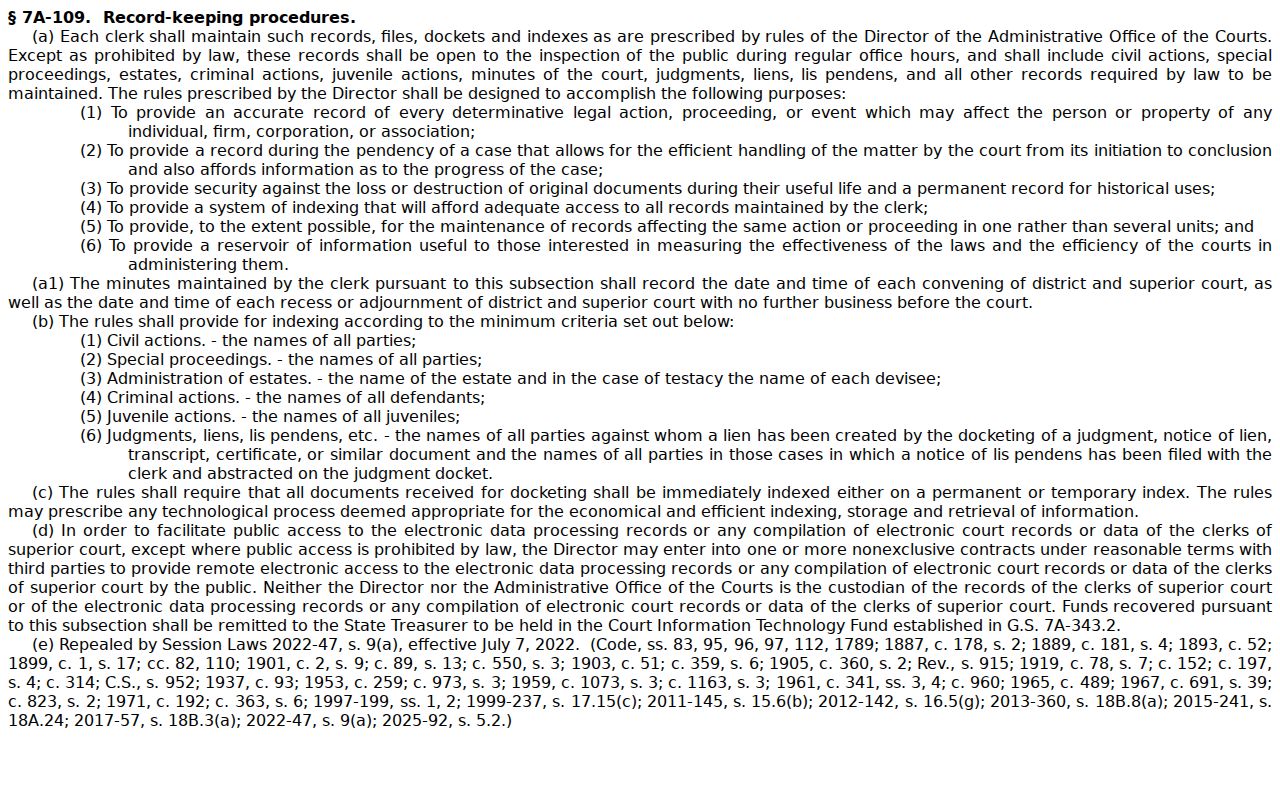
The statute supports the clerk-records framework while leaving confidentiality and sealing limits in place.
Lenoir Federal Court Record Split
Lenoir Superior Court and District Court files are North Carolina state-court records. Federal cases are different. A federal civil, criminal, bankruptcy, or appellate matter never sits with the Lenoir clerk. Lenoir County belongs to the U.S. District Court for the Eastern District of North Carolina. Its record processes are fully separate from the Lenoir Clerk of Superior Court. The Eastern District's official court page identifies the federal court layer. That layer covers any Lenoir-related federal matter.
The federal court keeps its own clerk, its own CM/ECF filing system, and its own record procedures. For federal docket and document access, use PACER. PACER requires its own account and follows current federal fee rules. Its home interface is the documented entry point.
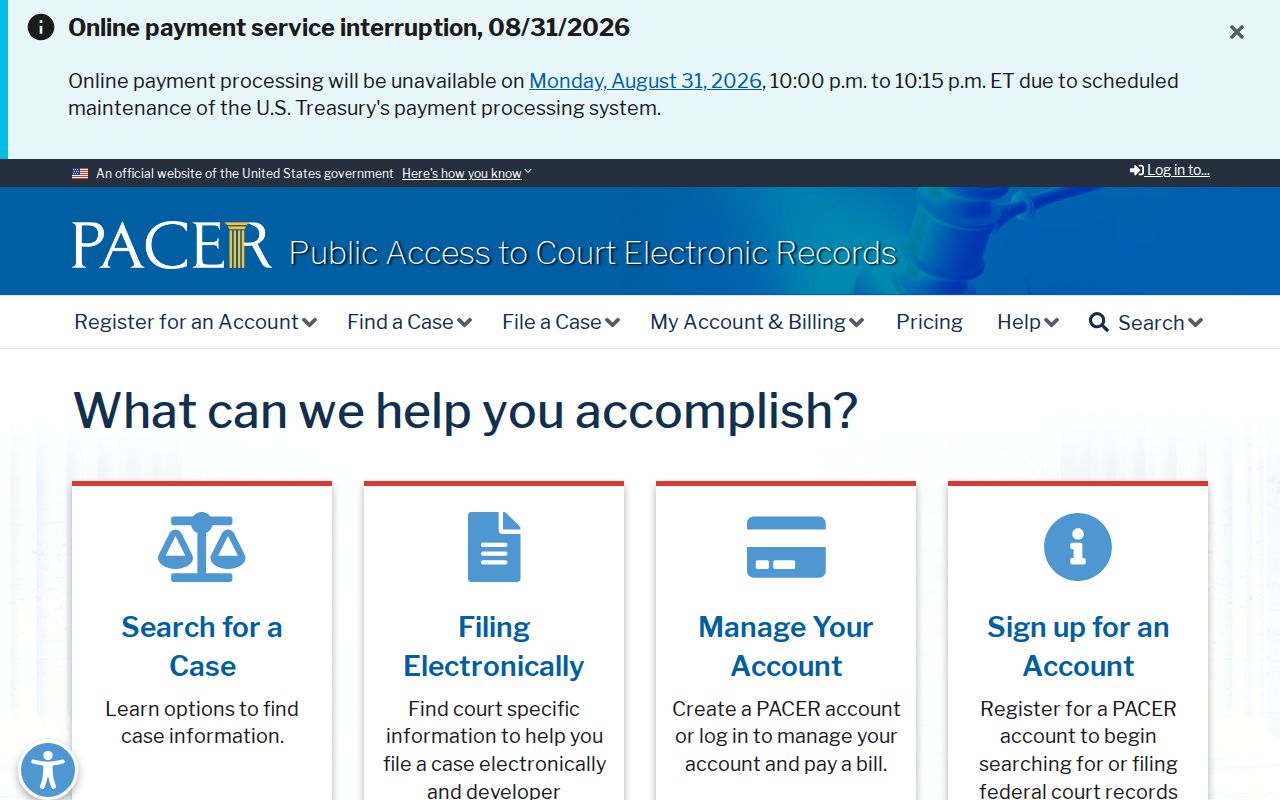
PACER's federal docket is separate from the Lenoir Register of Actions. A state-clerk request will not return a federal case.